

The February 2026 NYMEX contract rolled off the board this afternoon at $7.460 per MMBtu. The expiration came on the heels of seven consecutive up days, which saw pricing increase nearly 150% from lows near $3.00 per MMBtu as recently as January 16. This marks the highest NYMEX expiration price since September 2022 and the highest of any February contract since 2008.
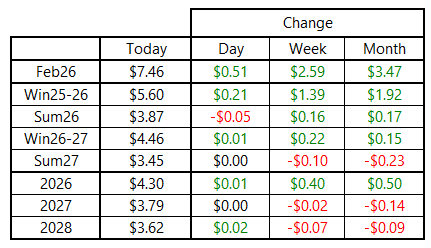
Price action was especially choppy on Wednesday amid low expiration-day liquidity. For much of the session, it appeared that February might give back some of the recent gains. However, the market jumped sharply higher after 2 p.m. Eastern, with the expiring contract trading in a wide range between $7.17 and $7.83 per MMBtu during its final half hour on the board. The expiration price marks the highest daily settlement in the 12-year trading history of the February 2026 contract.
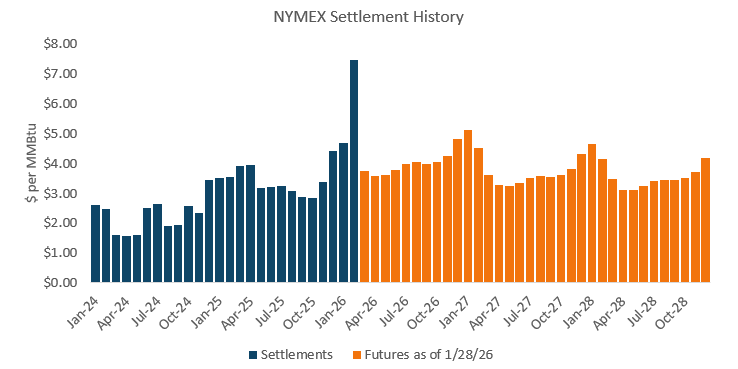
March 2026 will roll onto the front of the curve tomorrow at a deep discount to the February expiry. The soon-to-be prompt contract finished Tuesday at $3.732 per MMBtu.
Tomorrow’s storage report will give the market its first glimpse of the impact from this cold weather event. Temperatures were cooler than normal on average for the week ended January 23, which will be covered in the data, but the most extreme cold did not arrive until the very end of the report week. A Wall Street Journal survey of analysts showed expectations ranging from draws of 210 to 248 Bcf. The consensus is near 233 Bcf, which would modestly reduce the surplus to the five-year average while expanding the surplus to year-ago storage, which declined by 307 Bcf during the corresponding week.
Next week’s storage report will capture the lion’s share of the cold. Early expectations point to a draw well above 300 Bcf, with the all-time record weekly withdrawal of 359 Bcf potentially in jeopardy. In aggregate, tomorrow’s report combined with the following two are likely to reduce inventories by more than 800 Bcf—an outcome that has occurred only twice over a three-week period. The strongest such draw on record came in January 2018, when inventories fell by 830 Bcf, while last January saw a three-week draw of 801 Bcf.

An archive of Daily Natural Gas Market Notes can be found here.